A'Driane Nieves

January 12, 2022

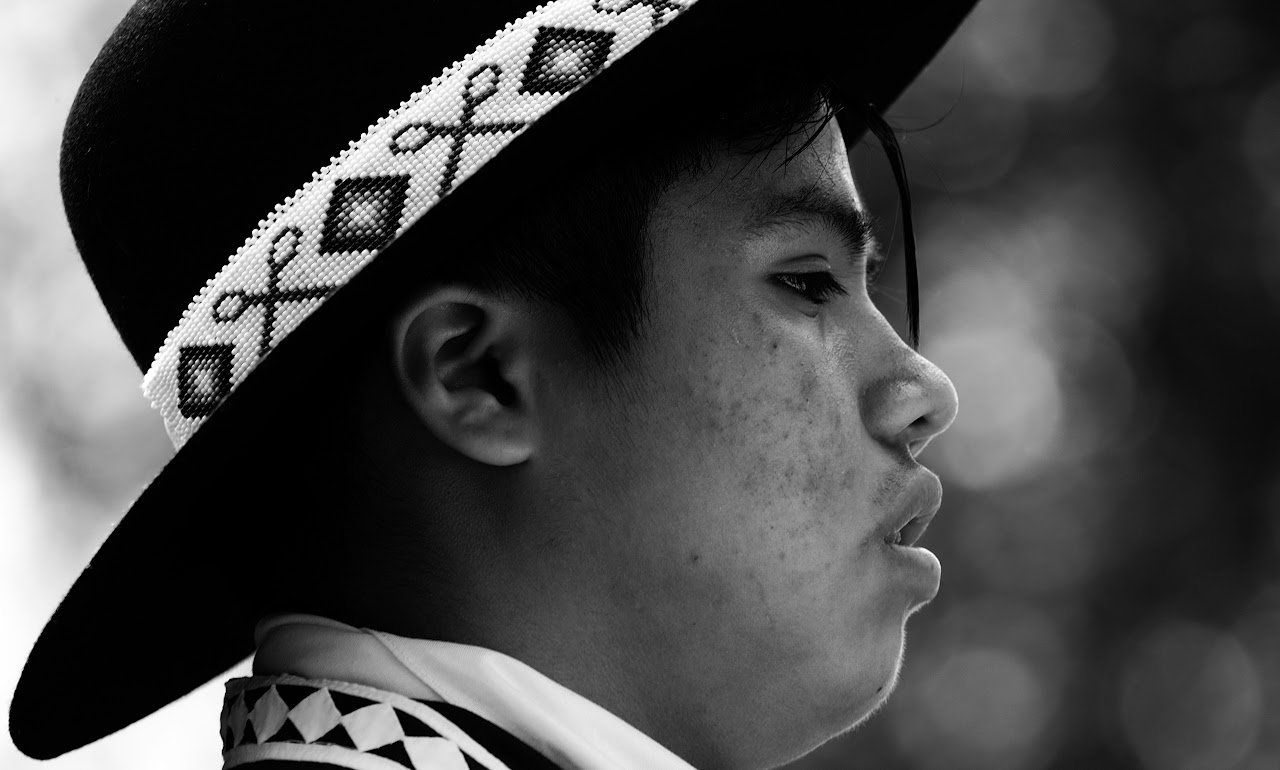
Based in North Philadelphia’s Kensington neighborhood, the Tessera Arts Collective (TAC) has only been around for two years but has already developed a broad slate of initiatives, from exhibitions, lectures, and workshops to its fledgling publication Abstractions Magazine and its “Free Art Bin” program, which makes small abstract works of art by Black and Brown women artists available for free. The TAC was founded by artist A’Driane Nieves to support and show the work of artists of color who are womxn (including femme, nonbinary, queer, and trans individuals) and who make abstract art.
Discussing her decision to create a space focused on showing abstract art in a recent interview with Artblog, Nieves explained that “as a Black person, especially, if you have had to fight for your survival, nothing about your existence or your imagination is abstract. Everything has to be concrete and tangible.” She added, “I really feel that people of color, especially, have a pretty significant disconnect with abstraction and another reason why I wanted to create a space like this in a community was to be able to give people that kind of access.”
New Button
By nat rosasco November 9, 2021
Bvlbancha Public Access is a media channel based in Bulbancha (New Orleans), Louisiana. They collect stories, facilitate art, and produce events on Indigenous identity in the Gulf South.
The Kresge Foundation. Sunset.
By Kylie Wheeler October 4, 2021
The Kresge Foundation is a private, national foundation that works to expand opportunities in America’s cities through grantmaking and social investing in arts and culture, education, environment, health, human services and community development, nationally and in Detroit, Memphis and New Orleans. In collaboration with their partners, they help create pathways for people with low incomes to improve life circumstances and join the economic mainstream.
Metris Arts Consulting. Planning, research, evaluation.
By Kylie Wheeler October 4, 2021
Metris Arts Consulting’s mission is to improve and measure cultural vitality. They believe in the power of culture to enrich people’s lives, help communities thrive, empower communities, and cultivate belonging. Their clients span the country and globe. They include government agencies, community and arts nonprofits, philanthropic foundations, and developers. Metris Arts Consulting helps them equitably advance cultural vitality (planning), fill knowledge gaps so that they can effectively incorporate arts and culture into their work (program development), and understand what difference their efforts make, why, and how (evaluation). They use a range of research and communication skills to advance understanding (research for field building). Their work in the realm of creative placemaking launched their practice. Over ten years in operation, Metris Arts Consulting has grown and diversified their services. Their team brings a combined 61 years of research, evaluation, and planning.
By nat rosasco July 22, 2021
At UCLA Medical Center, patients with serious medical complications caused by the COVID-19 virus are "singing their way to recovery" with opera lessons. Taught by members of the Los Angeles Opera and a music educator, the students are trained in opera singing techniques like diaphragmatic breathing, an exercise that strengthens their breathing muscles and supports their rehabilitation. Participants describe the experience as "soulful therapy," in which singing serves as a means to celebrate how far they've come.
By nat rosasco June 28, 2021
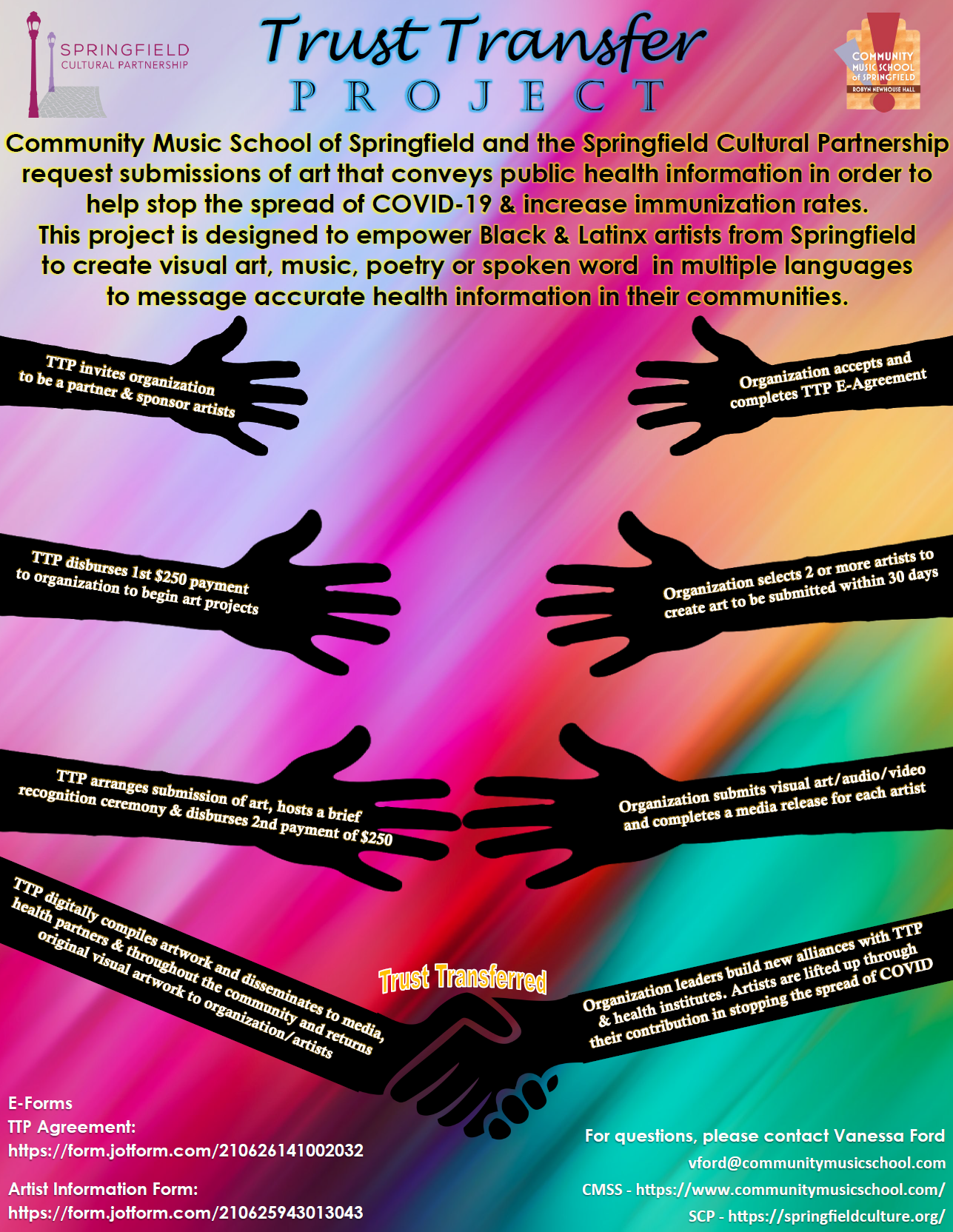
What is the Trust Transfer Project? Trust Transfer Project is a partnership between Community Music School of Springfield and Springfield Cultural Partnership, led by Program Director Vanessa Ford. This new initiative allows our local artists to lead in health messaging that will directly impact the lives of their family, neighbors and friends. This project model offers a unique opportunity for us to depend on one another to share and receive health messages in a creative and inspirational way. We’re building trust through the eyes of the most impacted by Covid-19. This project seeks to transform the health of our communities one artistic message at a time. Our incredibly talented and brave local artists are being lifted and supported by our dedicated community partners who range from small businesses to bodegas to churches & childcare centers to large institutions and organizations. Throughout Springfield in the months of June and July artists work (visual art, poetry music created by Trust Transfer artists will be displayed throughout the city to inspire and encourage community members to seek information, to engage in conversations about their health and stopping the spread of Covid-19. “I was honored & proud for my kids to create art, but also overwhelmed to find out how they felt about their 2020 experience, I had no idea that they felt so strongly about it. I thought they were just happy to be out of school, but I was so wrong, sometimes we don’t ask kids their perspective on things, but this project made me think differently.” said mother of Trust Transfer youth artists, Tina Tucker-Garner. In challenging times like these. We must have an anchor. After we’ve exhausted all of our other typical strategies for change, the only thing left is trust. Not just trust for this moment, but for moving forward. We’re planting a seed of trust now, watering it and giving it enough light to grow abundantly, branching out into the most vulnerable segments of our city with creative messages of truth, healing & hope for a better future for us all. — Vanessa Ford, Director of Trust Transfer Project. May 20, 2021 Read the full press release from CMSS/SCP here Read the full press release from Commonwealth of MA here
By nat rosasco June 11, 2021
Article Overview: One of the fundamental challenges in research on, and the practice of, anti-racism is helping people open their minds to new possibilities and new ways of thinking. This commentary illustrates how art can help people unlearn misinformation and narrow ways of thinking while enhancing flexibility that allows people to think creatively about efforts to eliminate or mitigate the health effects of racism. Historically, art has been a critical foundation of the history of protest and struggle to achieve equity in the United States and across the globe. Whether music, poems, paintings or other forms of creative expression, art has been at the core of efforts to express emotion, communicate difficult concepts, spur action and change what seems impossible. Art has been particularly important in illustrating and helping to facilitate how people understand what racism is, how it feels to experience privilege or oppression and exploring the implications of policies and practices that affect health indirectly or directly. Yet, art remains underutilized in anti-racism education, training and organizing efforts within public health. This commentary includes several arts-based examples to illustrate how art can facilitate insights, observations and strategies to address racism and achieve health equity. Art can be an important tool to facilitate moving past intellectual arguments that seek to explain, justify and excuse racism. Art may be particularly important in efforts to illuminate how racism operates in organizational or institutional contexts and to communicate hope, resilience, and strength amid what seems impossible.
Show more